Tell us about the job
Takes about a minute. No obligation.
Boiler repair in this area starts with what the system has already been running against. 123 severe weather events were recorded in Greene County, Pennsylvania between 2015 and 2024. At that rate, severe weather is a standing feature of the operating environment, and every heating season adds to what burners, circulator pumps, and heat exchangers have been asked to handle. A contractor working a boiler repair here will check those components for wear patterns that built over time. A cracked heat exchanger or a seized pump is more likely to trace back to years of hard cycling than to any individual event.
Boilers in housing stock this age have been through a long run of heating seasons, and what a contractor finds once a unit is opened often differs from what the call described. Half the homes in Greene County, Pennsylvania were built in 1960 or earlier (2020-2024 ACS 5-year). A heat exchanger in a system that has been serviced, patched, and kept running across that span of time collects fatigue in the metal and sediment in the lines that only shows up when the casing comes off. Valves corrode from the inside. Seals harden. The repair scope a contractor quotes before opening the unit and the one they quote after it are frequently different.
The Parts of a Boiler a Contractor Checks First
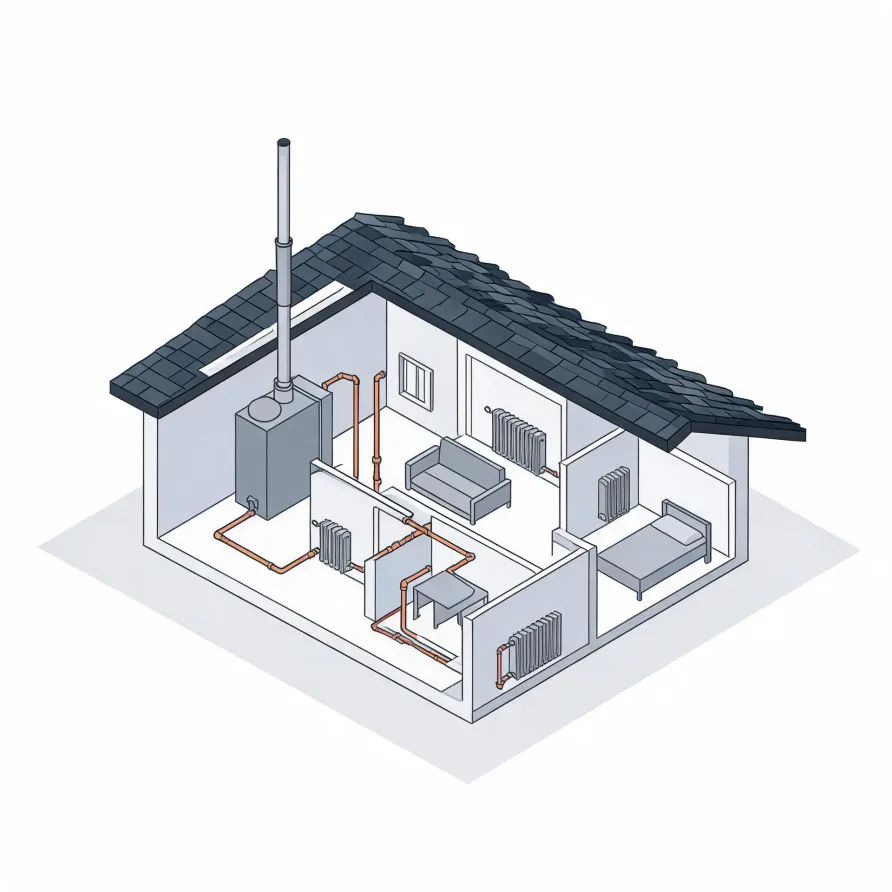
The boiler itself sits in the basement or a utility room and is where water gets heated before it moves through the house. The heat exchanger inside it is where contractors look first when a system stops producing heat or starts cycling oddly. The pressure relief valve, mounted directly on the boiler, is another early stop.
Pipes carry hot water out to the radiators or baseboard units in each room, and those terminal units are what the house actually feels. The circulator pump, usually attached near the boiler, moves water through that loop, and a failed pump is one of the more common reasons heat stops reaching certain rooms. The expansion tank, sitting close by, keeps system pressure stable.
The drawing shows a typical boiler layout, and a licensed contractor determines which parts apply to your specific system and what condition each one is in.
Find a contractor in Greene CountyGreene County, Pennsylvania, by the numbers
123 severe weather events were recorded in Greene County, Pennsylvania between 2015 and 2024.
NOAA National Centers for Environmental Information, Storm Events Database, bulk CSV export, events 2015-01-01 through 2024-12-31.Half the homes in Greene County, Pennsylvania were built in 1960 or earlier (2020-2024 ACS 5-year).
U.S. Census Bureau, 2020-2024 American Community Survey 5-Year EstimatesGreene County, Pennsylvania holds 16,201 housing units (2020-2024 ACS 5-year).
U.S. Census Bureau, 2020-2024 American Community Survey 5-Year EstimatesOwners occupy 77.1% of the occupied homes in Greene County, Pennsylvania (2020-2024 ACS 5-year).
U.S. Census Bureau, 2020-2024 American Community Survey 5-Year EstimatesBoiler Repair Rules & Standards on the Books in Greene County, Pennsylvania3 codes, standards & regs
Licensing and Legal Requirements in Greene County, Pennsylvania
Pennsylvania names the trade in its own definition: installing central heating or air conditioning is a home improvement under the Act, whether or not the equipment is affixed — so an HVAC installation is work the registration requirement reaches.
A Pennsylvania registration displaces the local one: no political subdivision may require a home improvement contractor to register, license or pay a fee on top of it, though building permits and local code enforcement still apply.
Pennsylvania requires home improvement contractor registration rather than a licence: nobody may hold themselves out as a contractor, or perform any home improvement, without first registering with the Bureau of Consumer Protection.
Weather Stress on Heating Systems in Greene County
Boilers work hardest when outdoor conditions push hard against a building's envelope. How much that happens in Greene County shapes how often the equipment inside needs attention.
123 severe weather events, 2015–2024. Source: NOAA National Centers for Environmental Information, Storm Events Database.