

Still doing its job
Copper lines run clean to the fittings, the expansion tank is solid, and the flue draws the way it should. A boiler kept up like this will keep carrying your house through January without much drama.
A local installer who puts in boilers gets your project.
Connect with a proWinters in Pennsylvania ask a lot of a boiler, and you're probably wondering how much life you've got left in yours, or whether the one you're about to put in will see you through the next couple decades. A boiler is a big purchase, so it's worth knowing what actually determines how long it keeps running before you're looking at replacement.
Most boilers here run 15 to 20 years before they need replacing, and some gas boilers that are well maintained get close to 25. That range holds because Pennsylvania winters put the boiler to work for months at a stretch, often October through April, and a system that runs that hard for that long wears differently than one that only kicks on a few weeks a year. Most homes here heat with gas, and gas boilers tend to hold up well over that stretch when the burner and heat exchanger are kept clean. What shortens that life is usually hard water scaling the inside of the tank or heat exchanger, or a system sized wrong for the house from the start. If yours came with the house, finding out its age and service history tells you more than its looks do.
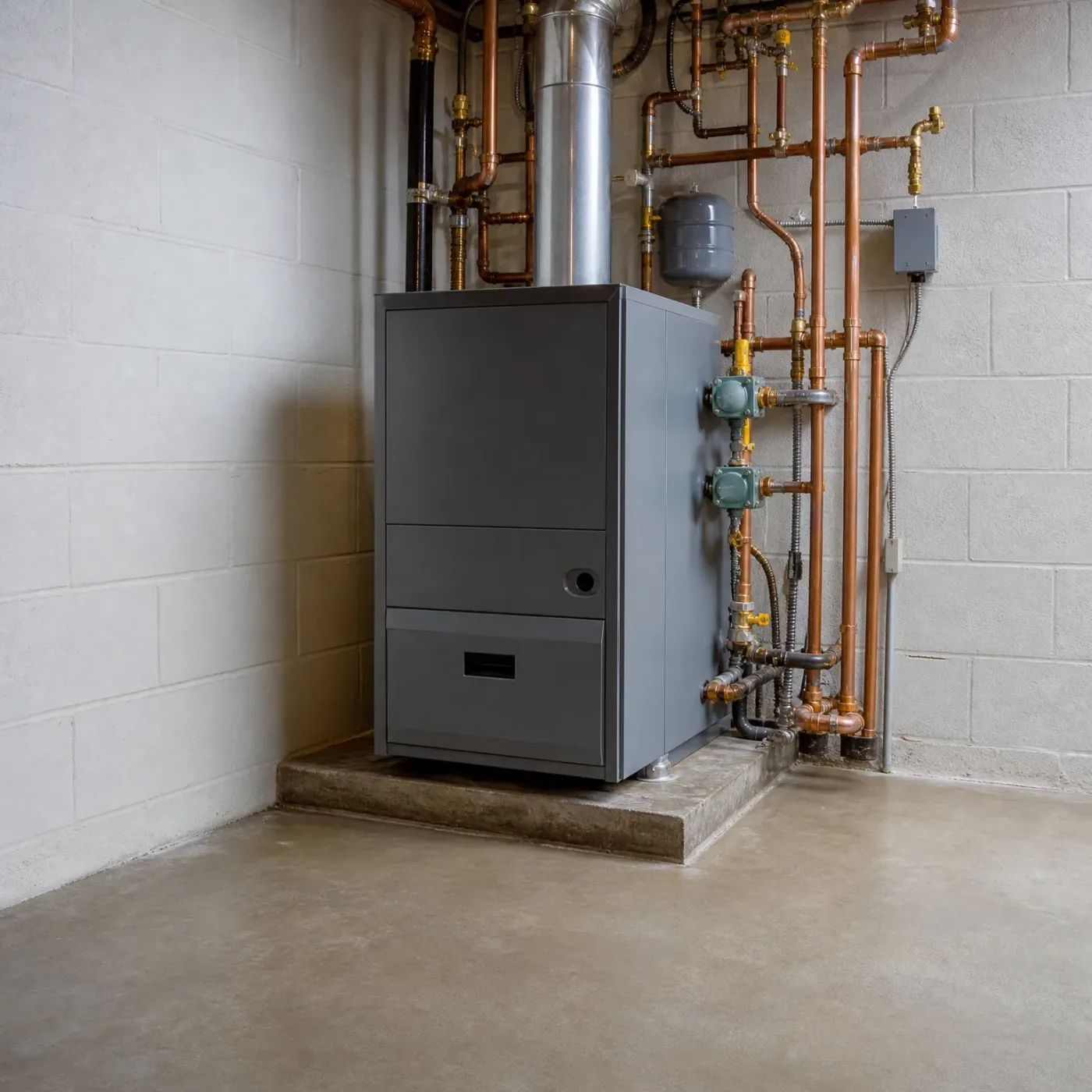
Copper lines run clean to the fittings, the expansion tank is solid, and the flue draws the way it should. A boiler kept up like this will keep carrying your house through January without much drama.
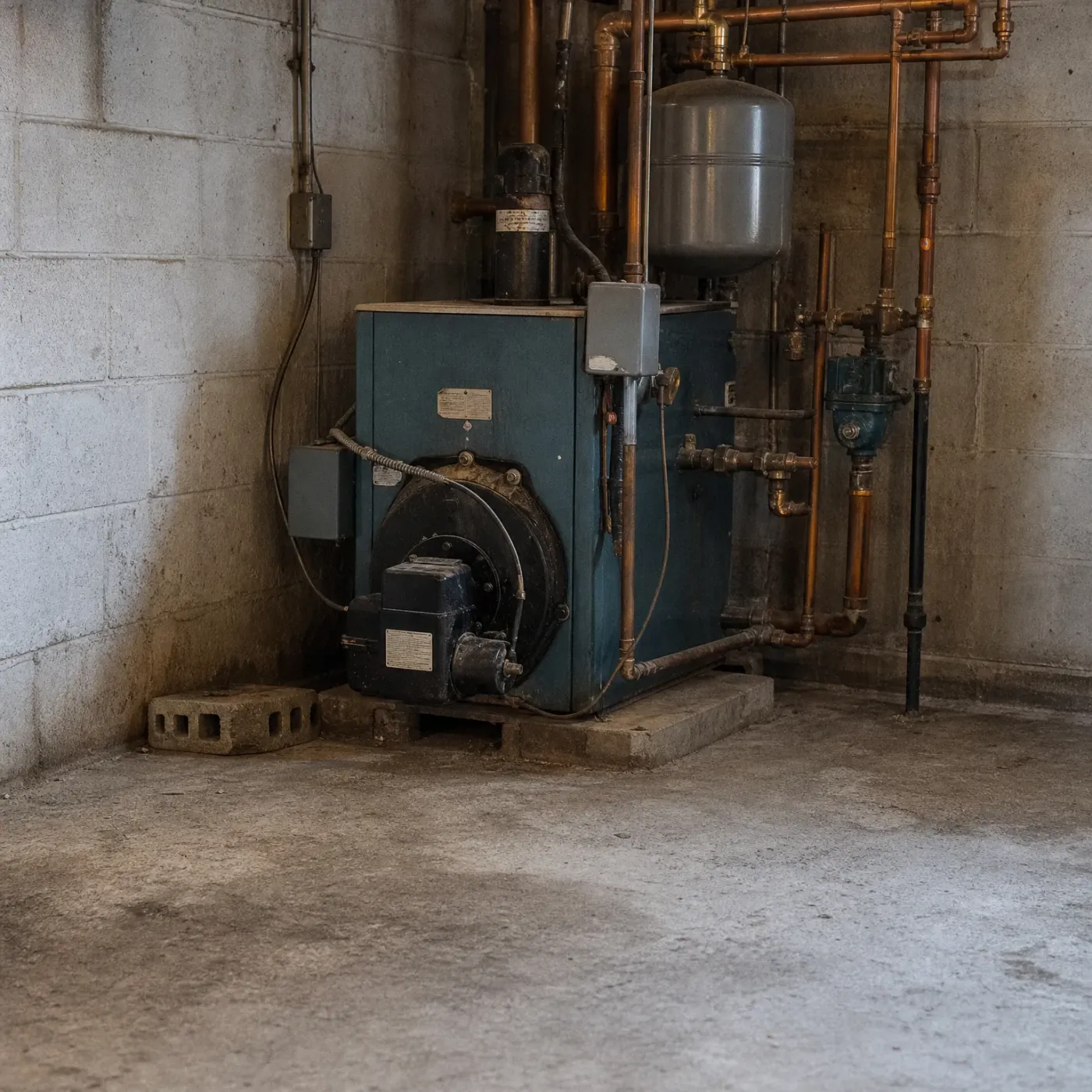
Iron pipe and copper mixed together like this usually means old repairs stacked on older ones. Once a boiler needs this much patched onto it, replacement is worth asking about before it fails on a cold night.
You might hear it before you see it. A boiler nearing the end bangs or kettles in the pipes, short cycles on and off, or takes longer to get your radiators warm than it used to. You may notice rust weeping from a fitting, or a patch of damp on the floor near the base where water's found a way out. The burner flame should be blue. If it's yellow or orange, or you smell something off when it fires, that's not a small thing, that points to a combustion problem worth having looked at. A boiler that's struggling in November usually isn't getting better by January, and a full failure means no heat until it's replaced.




A boiler that's banging, kettling, or leaving rust around the fittings isn't going to fix itself, and waiting usually means a cold snap decides the timeline for you instead of you deciding it. Getting a straight read on what's left in yours, or what a new one would mean for a Pennsylvania winter, takes someone who's actually inside these systems all season, not just reading a gauge. A local contractor who services boilers through the cold months here knows which brands hold up, what iron piping like yours tends to do after enough winters, and what a gas line conversion or venting change actually involves in a house like this one. You'll hear from one contractor, not a handful, so you're not fielding five calls to compare notes on the same questions. Before another January puts it to the test, it's worth having someone who knows this equipment take a real look at where yours stands.
A boiler doesn't make heat and blow it around like a furnace does. It heats water in a closed loop, sends it out to your radiators or baseboards, and pulls the cooled water back through the return line to go through the burner again. That loop runs for as long as the boiler does, and most of what shortens its life happens inside it, not around it. The heat exchanger sits right over the burner and takes the most punishment. Minerals in the water settle out as scale over the years, and that scale insulates the metal from the heat it's supposed to absorb, so the burner works harder and the metal runs hotter than it should. Cast iron exchangers handle that abuse for a long time, often decades, because the metal is thick and corrodes slowly. Steel exchangers cost less going in but tend to wear through sooner under the same scale buildup. Two other parts keep the system from damaging itself as the water heats and expands: the expansion tank absorbs the extra volume, and the pressure relief valve opens if pressure climbs past what the system should handle. If your boiler burns gas or oil, it vents exhaust through a flue, and poor draft there is often the first outward sign that something inside has started to go. The low water cutoff is the safety piece: it shuts the burner off if water level drops too low, which keeps the heat exchanger from firing dry and cracking.
At 23 degrees most nights from December through February, your boiler is holding a steady burn for hours at a stretch, not cycling on and off a few times like it might in a milder state. That steady demand is what wears down a heat exchanger over the years.
NOAA nClimDiv 1991-2020 county normals weighted by homes
A boiler in Pennsylvania runs a long time when it's cared for, and it tells you when it isn't. You've got the signs now: the sounds it makes, the rust, the slow radiators, the age where iron pipes start giving out and copper tends to hold. Some winters put more strain on a system than others, and a boiler that's been skipping maintenance will show its age faster than one that hasn't. Whatever you've found looking over yours, you don't have to figure out the rest alone. A local contractor who works on boilers all winter can look at what you've got and tell you straight whether it's got another few winters in it or whether you're better off planning the replacement now, before a cold stretch makes that decision for you.


A boiler pro near you
Only one pro gets your request, so you hear from one company.