Tell us about the job
Takes about a minute. No obligation.
A boiler repair in Clinton County starts with what the system has actually been through. 131 severe weather events were recorded in Clinton County, Pennsylvania between 2015 and 2024. At that rate, severe weather is a genuine part of the load a boiler carries here, but spread across years it is not the kind of relentless pressure that by itself wears a heat exchanger thin or kills a circulator pump. A contractor will check ignition components, pressure relief valves, and sediment buildup before landing on weather as the explanation. Age and deferred maintenance account for most of what fails.
Piping and zone valves in a house this old frequently carry the problem a homeowner thinks is coming from the boiler itself. Half the homes in Clinton County, Pennsylvania were built in 1967 or earlier (2020-2024 ACS 5-year). A contractor who opens the unit and finds it serviceable still has to work back through the distribution side, because scale buildup, sediment in the system, and zone valves that no longer seat correctly are what send heating calls in stock of this vintage. The boiler gets replaced last, after the piping tells its own story.
The Parts of a Boiler a Contractor Checks First
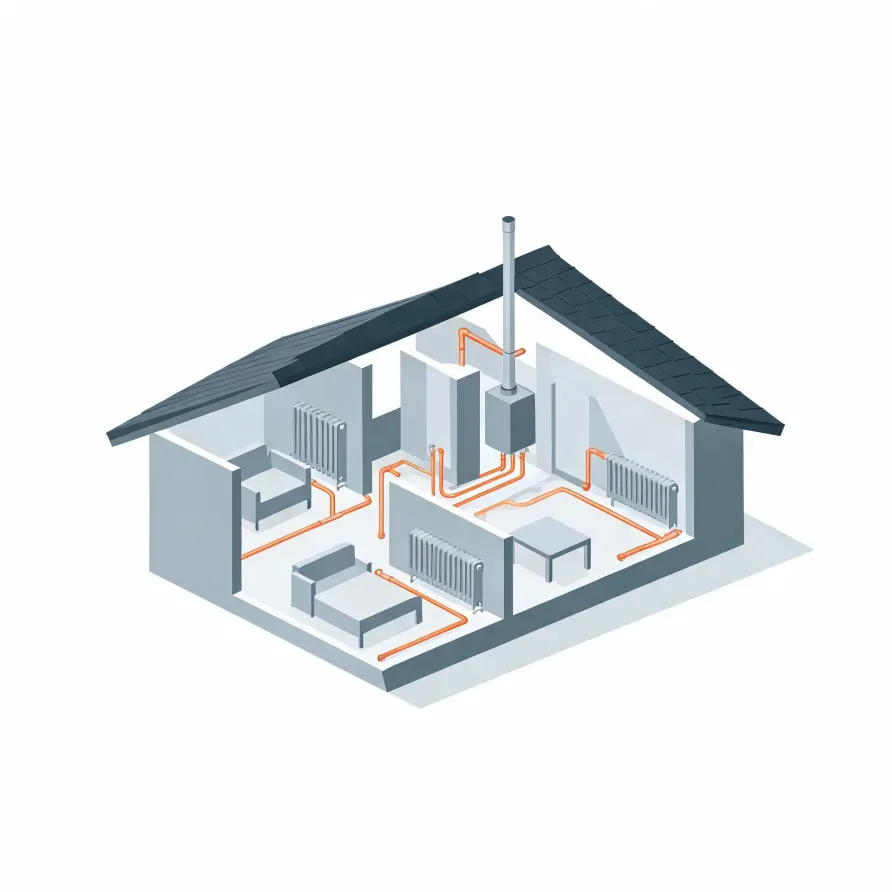
The boiler itself sits in the basement or a utility room and is the heart of the system. It heats water and pushes it out through the pipes. When something fails here, a contractor looks at the burner assembly, the heat exchanger, and the pressure vessel, since faults in any of those show up as no heat, strange sounds, or a system that shuts itself down.
Radiators or baseboard units sit in each room and release heat from the water flowing through them. The circulator pump, which moves that water around the loop, and the expansion tank, which keeps pressure stable, both live near the boiler. A thermostat on the wall ties the whole system together, and when readings there do not match what the boiler is doing, that gap often points a contractor toward the controls or the pump.
The drawing shows the general layout of a boiler system, and a licensed contractor determines which components and conditions apply to your specific home.
Find a contractor in Clinton CountyClinton County, by the numbers
131 severe weather events were recorded in Clinton County, Pennsylvania between 2015 and 2024.
NOAA National Centers for Environmental Information, Storm Events Database, bulk CSV export, events 2015-01-01 through 2024-12-31.Half the homes in Clinton County, Pennsylvania were built in 1967 or earlier (2020-2024 ACS 5-year).
U.S. Census Bureau, 2020-2024 American Community Survey 5-Year EstimatesClinton County, Pennsylvania holds 18,617 housing units (2020-2024 ACS 5-year).
U.S. Census Bureau, 2020-2024 American Community Survey 5-Year EstimatesOwners occupy 72.3% of the occupied homes in Clinton County, Pennsylvania (2020-2024 ACS 5-year).
U.S. Census Bureau, 2020-2024 American Community Survey 5-Year EstimatesBoiler Repair Rules That Apply in Clinton County, Pennsylvania3 codes, standards & laws
Licensing and Legal Requirements in Clinton County, Pennsylvania
Pennsylvania names the trade in its own definition: installing central heating or air conditioning is a home improvement under the Act, whether or not the equipment is affixed — so an HVAC installation is work the registration requirement reaches.
A Pennsylvania registration displaces the local one: no political subdivision may require a home improvement contractor to register, license or pay a fee on top of it, though building permits and local code enforcement still apply.
Pennsylvania requires home improvement contractor registration rather than a licence: nobody may hold themselves out as a contractor, or perform any home improvement, without first registering with the Bureau of Consumer Protection.
Severe Weather Events in Clinton County, Year by Year
Heating equipment works harder and breaks down faster in places where the weather swings hard. A boiler serving Clinton County homes carries a workload shaped by local conditions, and that makes repair history here different from repair history somewhere else.
131 severe weather events, 2015–2024. Source: NOAA National Centers for Environmental Information, Storm Events Database.