Tell us about the job
Takes about a minute. No obligation.
A boiler repair call in this county starts with the system's service history, not the weather outside. 99 severe weather events were recorded in Schuylkill County, Pennsylvania between 2015 and 2024. That puts severe weather somewhere between a standing condition and a rare event, and a contractor diagnosing a boiler failure here will look at the heat exchanger, the burner assembly, and the age of the controls before they reach for weather load as an explanation. A unit that has been skipping annual service will show it in ways that storm seasons do not produce.
Boilers running in houses this old have often been serviced by several hands over the decades, and what a contractor finds once a unit is opened reflects that history in concrete ways: corroded fittings, non-standard adapters, heat exchangers from manufacturers that no longer supply parts. Half the homes in Schuylkill County, Pennsylvania were built in 1946 or earlier (2020-2024 ACS 5-year). That span between when these walls went up and what is running in them now is where repair scopes get complicated. A contractor working a boiler job here will check what parts the system actually takes before pricing the repair, because a component that appears available in a catalog sometimes turns out to be superseded or simply gone from the supply chain.
The Parts of a Boiler a Contractor Checks First
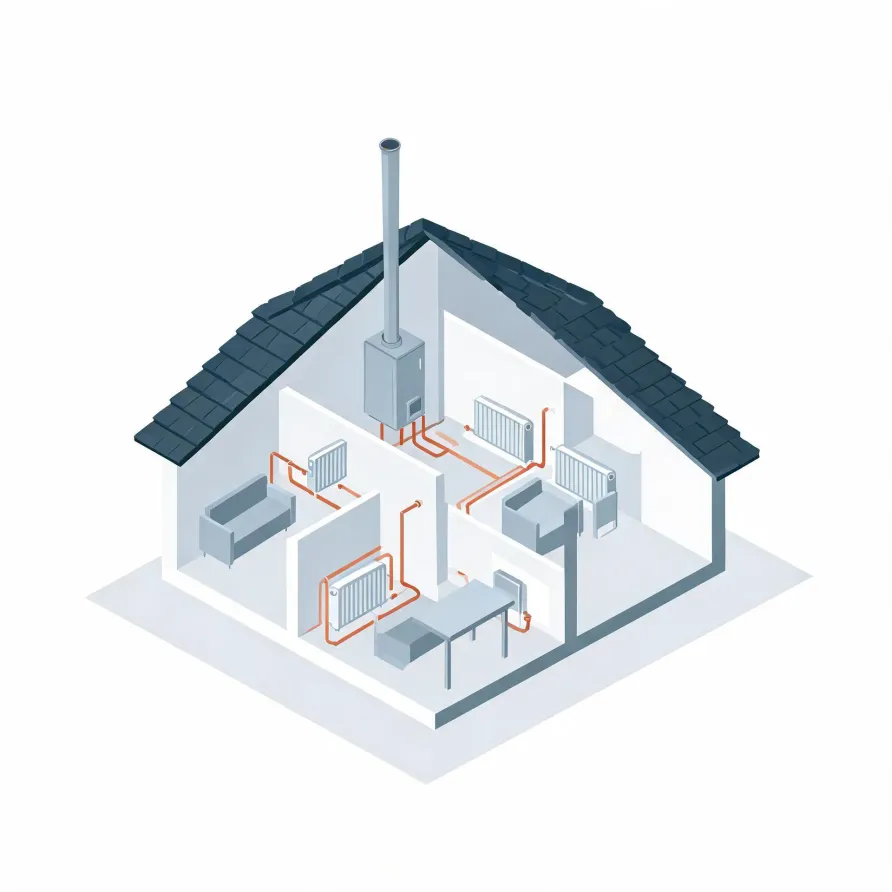
The boiler itself sits in the basement or a utility room and is the heart of the system. It heats water and pushes it out to the rest of the house. When something goes wrong, a contractor starts here: checking the heat exchanger for cracks, the burner for ignition problems, and the pressure vessel for leaks or buildup that chokes output.
From the boiler, pipes carry hot water to radiators or baseboard units in each room, then back again. The circulator pump moves that water through the loop, and the expansion tank absorbs pressure changes as the water heats and cools. A failed pump means no heat reaches the rooms; a waterlogged expansion tank drives pressure swings that trip the safety relief valve.
The drawing shows a typical boiler layout, and a licensed contractor will determine which components apply to your specific system.
Find a contractor in Schuylkill CountySchuylkill County, by the record
99 severe weather events were recorded in Schuylkill County, Pennsylvania between 2015 and 2024.
NOAA National Centers for Environmental Information, Storm Events Database, bulk CSV export, events 2015-01-01 through 2024-12-31.Half the homes in Schuylkill County, Pennsylvania were built in 1946 or earlier (2020-2024 ACS 5-year).
U.S. Census Bureau, 2020-2024 American Community Survey 5-Year EstimatesSchuylkill County, Pennsylvania holds 67,295 housing units (2020-2024 ACS 5-year).
U.S. Census Bureau, 2020-2024 American Community Survey 5-Year EstimatesOwners occupy 76.1% of the occupied homes in Schuylkill County, Pennsylvania (2020-2024 ACS 5-year).
U.S. Census Bureau, 2020-2024 American Community Survey 5-Year EstimatesBoiler Repair Rules & Codes for Schuylkill County, Pennsylvania3 sourced rules and standards
Licensing and Legal Requirements in Schuylkill County, Pennsylvania
Pennsylvania names the trade in its own definition: installing central heating or air conditioning is a home improvement under the Act, whether or not the equipment is affixed — so an HVAC installation is work the registration requirement reaches.
A Pennsylvania registration displaces the local one: no political subdivision may require a home improvement contractor to register, license or pay a fee on top of it, though building permits and local code enforcement still apply.
Pennsylvania requires home improvement contractor registration rather than a licence: nobody may hold themselves out as a contractor, or perform any home improvement, without first registering with the Bureau of Consumer Protection.
Severe Weather Events in Schuylkill County
Extreme weather puts real stress on boiler systems, and Schuylkill County has its own weather history that shapes how hard local equipment works. That workload is part of what drives repair needs here.
99 severe weather events, 2015–2024. Source: NOAA National Centers for Environmental Information, Storm Events Database.