Tell us about the job
Takes about a minute. No obligation.
A boiler repair in Carbon County starts with what the equipment has actually been through. 110 severe weather events were recorded in Carbon County, Pennsylvania between 2015 and 2024. That rate of severe weather puts a steady load on heating systems over time, and a contractor will check components that absorb that load: heat exchangers, expansion tanks, pressure relief valves. But the weather alone rarely explains why a specific boiler failed. Age of the unit and how well it was installed and serviced are what tip a system into a repair call. A contractor quoting the job has to separate those causes before the scope of work makes sense.
Half the homes in Carbon County, Pennsylvania were built in 1972 or earlier (2020-2024 ACS 5-year). A boiler that has been running through that span of time collects a particular kind of history inside it: sediment in the heat exchanger, worn seals that have been patched rather than replaced, controls that predate current parts availability. When a contractor opens the unit, what they find determines whether the job is a single component swap or a broader scope of work. Parts for systems this old are sometimes still made and sometimes sourced from shrinking supply chains, and that distinction sets the final bill more than the symptom that prompted the call.
The Parts of a Boiler a Contractor Checks First
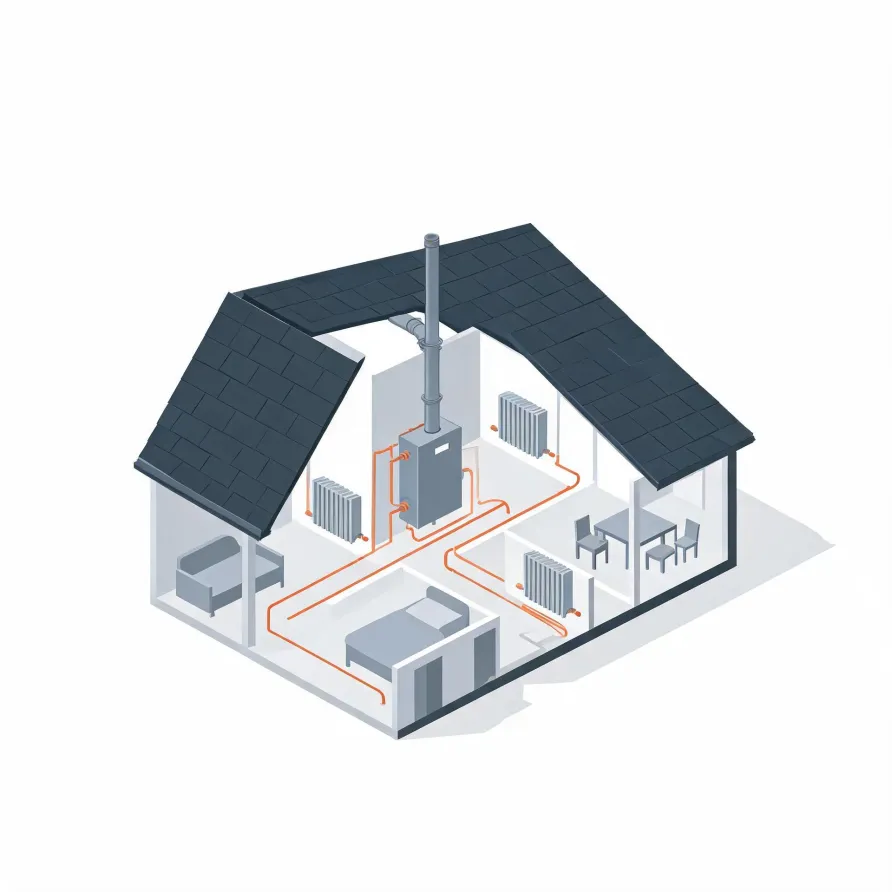
The boiler itself sits in the basement or a mechanical room and is the heart of the system. It heats water and pushes it through the pipes. When a homeowner notices no heat, strange sounds, or pressure problems, the boiler unit and its burner assembly are where a contractor looks first.
From the boiler, supply pipes carry hot water to radiators or baseboard units in each room, and return pipes bring the cooled water back. The expansion tank, circulator pump, and pressure relief valve all live close to the boiler. Any one of them can be the source of a fault.
The drawing shows a typical boiler layout, and a licensed contractor determines which components apply to your specific home.
Find a contractor in Carbon CountyCarbon County, by the record
110 severe weather events were recorded in Carbon County, Pennsylvania between 2015 and 2024.
NOAA National Centers for Environmental Information, Storm Events Database, bulk CSV export, events 2015-01-01 through 2024-12-31.Half the homes in Carbon County, Pennsylvania were built in 1972 or earlier (2020-2024 ACS 5-year).
U.S. Census Bureau, 2020-2024 American Community Survey 5-Year EstimatesCarbon County, Pennsylvania holds 34,417 housing units (2020-2024 ACS 5-year).
U.S. Census Bureau, 2020-2024 American Community Survey 5-Year EstimatesOwners occupy 76.4% of the occupied homes in Carbon County, Pennsylvania (2020-2024 ACS 5-year).
U.S. Census Bureau, 2020-2024 American Community Survey 5-Year EstimatesBoiler Repair Rules & Standards for Carbon County, Pennsylvania3 sourced regulations and codes
Licensing Rules for HVAC Repair in Carbon County, Pennsylvania
Pennsylvania names the trade in its own definition: installing central heating or air conditioning is a home improvement under the Act, whether or not the equipment is affixed — so an HVAC installation is work the registration requirement reaches.
A Pennsylvania registration displaces the local one: no political subdivision may require a home improvement contractor to register, license or pay a fee on top of it, though building permits and local code enforcement still apply.
Pennsylvania requires home improvement contractor registration rather than a licence: nobody may hold themselves out as a contractor, or perform any home improvement, without first registering with the Bureau of Consumer Protection.
Severe Weather Events in Carbon County
Boilers work hardest when outside conditions push hardest against them. Weather stress accumulates in the equipment, and in Carbon County that makes heating repair a local trade, not a general one.
110 severe weather events, 2015–2024. Source: NOAA National Centers for Environmental Information, Storm Events Database.