Tell us about the job
Takes about a minute. No obligation.
A boiler repair quote in Lehigh County starts with more variables than in quieter parts of the country. 283 severe weather events were recorded in Lehigh County, Pennsylvania between 2015 and 2024. At that rate, severe weather is a standing condition rather than an occasional disruption, and it leaves real wear on heat exchangers, pressure relief valves, and expansion tanks over time. A contractor here cannot hand a homeowner a diagnosis built only on age or maintenance history without first accounting for what the system has been running against.
Boilers in a lot of these houses have been running through decades of freeze cycles, hard water, and sediment buildup, and what a contractor finds once the unit is open reflects all of it. Half the homes in Lehigh County, Pennsylvania were built in 1968 or earlier (2020-2024 ACS 5-year). Cast-iron sections crack, pressure relief valves seize, and aquastats from manufacturers who no longer supply replacement parts turn up regularly in basements across the county. A contractor pricing a repair has to open the system before quoting, because the condition of the heat exchanger and the availability of the parts it takes are what the job actually costs.
The Parts of a Boiler a Contractor Checks First
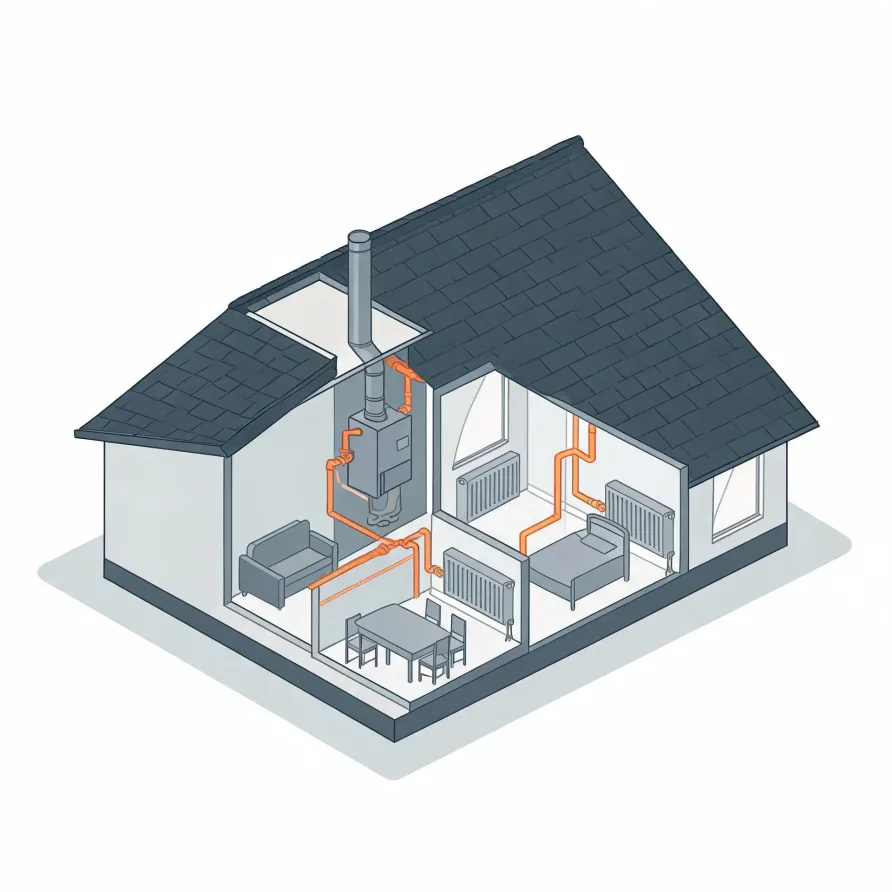
The boiler itself sits in the basement or a mechanical room and is the piece a contractor goes to first. It heats water and pushes it through the system. When heat stops reaching the rooms, or the unit cycles on and off without warming anything, the burner assembly, heat exchanger, or pressure relief valve is usually where the problem is found.
Copper or steel pipes carry that heated water out to the radiators or baseboard units in each room, and back again. The circulator pump moves water through those pipes, and the expansion tank absorbs pressure changes as water heats and cools. A failed pump or a waterlogged expansion tank each produce symptoms that look similar, so a contractor checks both.
The drawing shows the general layout of a boiler system, and a licensed contractor determines which components and conditions apply to your specific house.
Find a contractor in Lehigh CountyLehigh County, by the numbers
283 severe weather events were recorded in Lehigh County, Pennsylvania between 2015 and 2024.
NOAA National Centers for Environmental Information, Storm Events Database, bulk CSV export, events 2015-01-01 through 2024-12-31.Half the homes in Lehigh County, Pennsylvania were built in 1968 or earlier (2020-2024 ACS 5-year).
U.S. Census Bureau, 2020-2024 American Community Survey 5-Year EstimatesLehigh County, Pennsylvania holds 151,220 housing units (2020-2024 ACS 5-year).
U.S. Census Bureau, 2020-2024 American Community Survey 5-Year EstimatesOwners occupy 65.6% of the occupied homes in Lehigh County, Pennsylvania (2020-2024 ACS 5-year).
U.S. Census Bureau, 2020-2024 American Community Survey 5-Year EstimatesCodes & Standards Governing Boiler Repair in Lehigh County, Pennsylvania3 sourced rules and standards
Licensing and Legal Requirements in Lehigh County, Pennsylvania
Pennsylvania names the trade in its own definition: installing central heating or air conditioning is a home improvement under the Act, whether or not the equipment is affixed — so an HVAC installation is work the registration requirement reaches.
A Pennsylvania registration displaces the local one: no political subdivision may require a home improvement contractor to register, license or pay a fee on top of it, though building permits and local code enforcement still apply.
Pennsylvania requires home improvement contractor registration rather than a licence: nobody may hold themselves out as a contractor, or perform any home improvement, without first registering with the Bureau of Consumer Protection.
Severe Weather Events in Lehigh County
Extreme weather puts stress on boilers in ways that accumulate over time. How hard that equipment works is a local question, and the record of weather events here shapes what repair work looks like in this area.
283 severe weather events, 2015–2024. Source: NOAA National Centers for Environmental Information, Storm Events Database.